Tetsuo (The Iron Man)

Tetsuo (The Iron Man)

Tetsuo (The Iron Man)
Directed by Shin’ya Tsukamoto
Japan 1989

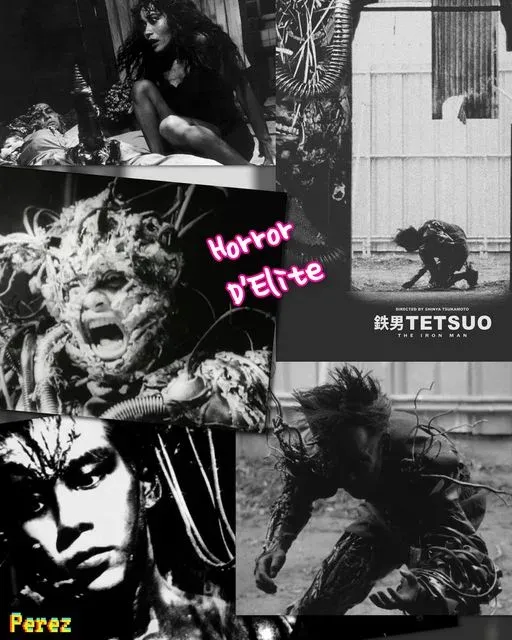
A businessman and his girlfriend are involved in a car accident where they run over a stranger.

After hiding the body, they return home, but from that moment on, the man who was driving starts experiencing visions, nightmares, and, most disturbingly, he begins to see metal parts gradually emerging from his own body.

Tetsuo (The Iron Man) is not only a visionary manifesto of horror cinema blended with cyberpunk culture but also a journey into the deepest layers of the human mind and a sharply defined social context, reflecting Japan’s progressive and futuristic culture and attitudes.

Dialogue is minimal, almost non-existent, as it’s the images that speak: powerful, dreamlike, transgressive, and disturbing.

The pain of the body mutating is palpable:

Flesh merges with metal, produces metal, and is possessed by metal.

The staging is impeccable, technically impressive thanks to perfect stylistic choices such as the black-and-white film, the frequent use of stop motion, and the frenetic energy of the imagery, heightened by close-ups and continuous zoom-ins.

Tsukamoto wears his influences on his sleeve throughout the film: Cronenberg’s body horror, Cameron’s cyborg from Terminator, the use of eroticism and sexuality as a tool of fatal persuasion, the difficulty in accepting change, and man’s relationship with technology. All of this is expressed through a minimalist yet extreme visual language that lasts until the closing credits, accompanied by a stunning and nervously charged soundtrack.

Pan-Demonic Moment

The famous scene where the protagonist’s phallic drill kills his girlfriend during intercourse.


Subscribe to our channel on YouTube 
Similar Posts

  • Cannibal Holocaust

    Four young people are sent to the Amazon by a television company to produce a documentary on the local tribes. After two months of complete silence, Professor Munro sets out to search for the missing crew, trying to retrace their steps. Once he finds the tapes shot by the team, he returns to the United States to review them, and only then does he uncover a horrific truth.

  • The Sadness

    Taipei, an ordinary morning. A couple is getting ready to start their day and go about their usual tasks, unaware of what’s unfolding around them. Soon, however, they realize that everything is gradually changing: a mysterious and deadly virus is turning the country’s population into insane killers.

  • Buio Omega

    Francesco is a noble and skilled embalmer who lives in a mansion in the mountains with his housekeeper, Iris. Secretly in love with him, Iris one day pays a witch to cast a curse on Francesco’s fiancée, Anna, who dies suddenly. Francesco is devastated, and after the funeral and burial, he decides to exhume Anna’s body, embalm it, and keep it in his home. This will be just the first extreme episode, followed by others that will drag the young man into a spiral of madness and murder.

  • Bone Tomahawk

    The tranquility of the small village of Bright Hope is shattered by a disturbing nighttime event: Samantha (a nurse), an injured criminal, and the young deputy sheriff have vanished without a trace.
    It is soon discovered that they were taken by a tribe of cannibalistic cavemen. The sheriff and three other men, including the woman’s husband, decide to set out to find and rescue the unfortunate victims.

  • The Golden Glove

    Hamburg, early 70s Fritz Honka is an alcoholic laborer who frequently visits Der Goldenen Handschuh, the pub in his neighborhood. Here, besides getting heavily drunk almost every night, he approaches women and prostitutes, whom he takes back to his home with the intention of having sexual relations. However, due to impotence caused by his alcoholism and the man’s repressed anger, these seduction attempts often end in tragedy.

Leave a Reply

Your email address will not be published. Required fields are marked *