
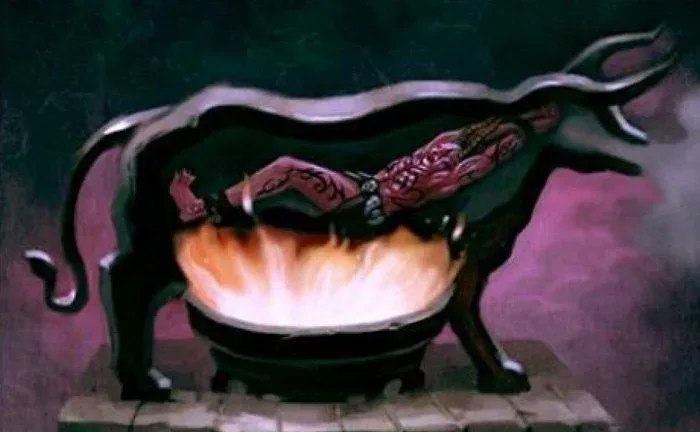
The Bull of Phalaris

Between Mythology and Horror
The Bull of Phalaris, also known as the Bronze Bull of Phalaris or the Sicilian Bull, stands as one of the most horrific and infamous inventions of ancient history. This macabre instrument of torture is tied to the Greek tyrant Phalaris, who ruled the city of Agrigento in Sicily in the 6th century BC. The story of the Bull of Phalaris is a narrative of human cruelty and how power can be warped for wicked purposes.
Origins and Construction
According to legend, it was designed and built by Perillos of Athens, a craftsman who responded to the tyrant’s request to create an unparalleled torture device. The bull was a life-sized bronze statue of a real bull, with a door on the front through which the victim was inserted. Once inside, the bull was heated until it became red-hot, slowly burning the victim alive within.
Use and Significance
The Bull was not only a means of physical torture but also a symbol of tyrannical power and injustice. Phalaris used it to punish those who dared to challenge his rule or to intimidate his subjects, creating an atmosphere of terror and obedience. Its ruthless use fueled the legend of the bloodthirsty tyrant, solidifying his control over the city and the surrounding region.
Legends and Myths
he story of the Bull has become an integral part of ancient Greek folklore, with numerous legends and tales surrounding its origin and fate. One of the most well-known legends tells of how Phalaris was ultimately condemned to suffer the same fate as his bull, being burned alive inside it by order of the king of Syracuse, Gelon. This final act of poetically tragic justice helped cement Phalaris’s reputation as one of history’s most ruthless tyrants.
Cultural Legacy
The Bull has left an indelible mark on culture and collective consciousness, symbolizing cruelty and tyranny throughout the centuries. Its story has been told and reinterpreted in works of art, literature, and theater, serving as a warning against the abuse of power and violence in all its forms.
In conclusion, the Bull of Phalaris remains a vivid illustration of humanity’s capacity to inflict suffering and terror on its own kind. Its story reminds us of the importance of resisting tyranny and defending the values of humanity to prevent such horrors from repeating in future history.