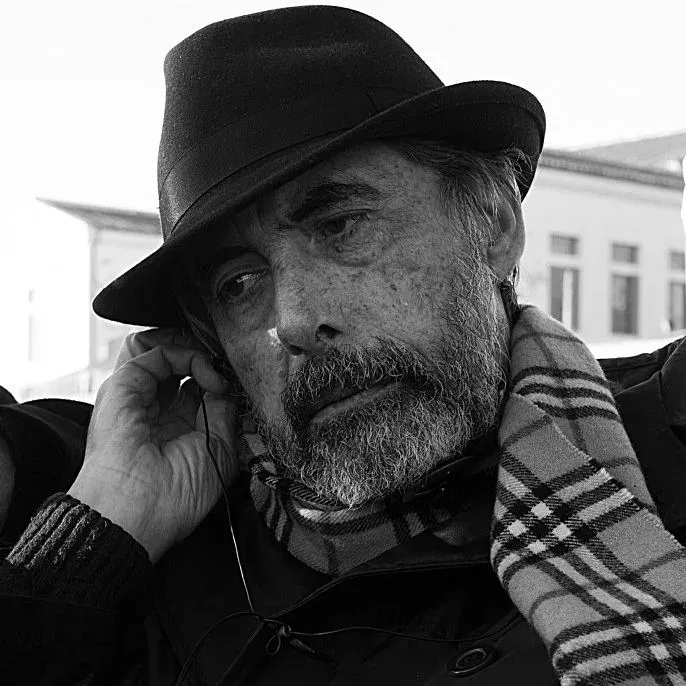
Claudio Caligari

Claudio Caligari (1948-2015) was an Italian director and screenwriter known for his work in independent cinema. His career, though brief and characterized by a limited number of films, left a significant mark on the Italian cinematic landscape thanks to his authentic and raw vision of social reality.
“I’m dying like a jerk and I’ve only made three films”
Filmography
Claudio Caligari was a true cult director for a certain underground cinema.
He started with four documentaries, all made between 1976 and 1978, before debuting with his first feature film, “Amore Tossico,” in 1983.
This debut film is a realistic and raw portrait of the world of drug addiction in Ostia, Rome. It became a cult classic for its documentary style and unfiltered depiction of the lives of addicts. Caligari used non-professional actors to enhance the realism.
After a gap of fifteen years, he returned with “L’Odore della Notte” in 1998. Based on the novel “Le Notti di Arancia Meccanica” by Dido Sacchettoni, this film tells the story of a gang of criminals in 1970s Rome. It was appreciated for its dark atmosphere and the depth of its characters.
His final work, released in 2015, is titled “Non Essere Cattivo.”
This film, released posthumously, is a portrait of the lives of two friends in the Roman suburbs of the 1990s, dealing with drugs and crime. It was enthusiastically received by critics and won numerous awards, including an Oscar nomination for Best Foreign Film. Its posthumous release helped to solidify Caligari’s myth as a master of Italian social cinema.
Style and Themes
Claudio Caligari is known for his realistic and direct style, often compared to Italian neorealism.
His works explore themes such as drug addiction, crime, and social marginalization with an empathetic and non-judgmental approach. His cinema is characterized by an authentic representation of reality, aiming to give a voice to those often ignored by society.
Legacy
Despite his limited filmography, Claudio Caligari is considered a cult figure in Italian cinema. His films have influenced a generation of directors and continue to be studied and appreciated for their honesty and emotional depth. His ability to portray the lives of marginalized people with respect and authenticity distinguishes him as one of the most important filmmakers of his time.