The Blair Witch Project – The Mystery of the Blair Witch

 The Blair Witch Project – The Mystery of the Blair Witch
by Daniel Myrick and Eduardo Sánchez (1999)
Three film students head to the woods of Burkittsville, Maryland, to make a documentary about the local legend of the Blair Witch.
Quote.
I’m afraid to close my eyes… and I’m afraid to open them. (Heather)
 Cinema in the Internet Age.
 Cinema in the Internet Age.
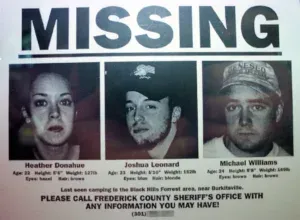
Let’s be honest: in 1999, the year of its release, watching this film became something of a sociocultural imperative. Behind it was a brilliant advertising campaign, though not entirely original (consider the illustrious predecessor represented by Deodato’s “Cannibal Holocaust”).
A legend, that of the Blair Witch, was artfully created on the Internet at no cost. And it was the various news circulated online that made a difference, compared to similar operations conducted in the past.
The Internet allowed for reaching a much wider audience. Everyone thus had the opportunity to learn about the mysterious disappearance of the three protagonists and the subsequent discovery of their last footage filmed in the woods.
Everything was perfectly orchestrated to create a frenzy of anticipation and high expectations around the product.
This operation was a complete success, considering the incredible box office returns of the film, which cost $25,000 and went on to earn $250 million over the years.
The Blair Witch Project – The Mystery of the Blair Witch became the second highest-grossing film of all time, in terms of profit.
 Considerations.
 Considerations.
But ultimately, what is The Blair Witch Project – The Mystery of the Blair Witch?
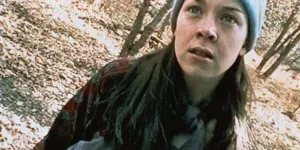
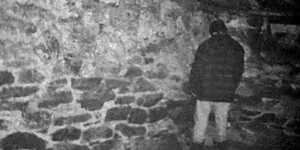
It’s a so-called “mockumentary,” filmed deliberately in POV, in a very raw manner, with handheld cameras and poor lighting to increase realism.
Something not very different from the short films that many of us might have made with friends in our youth.
Technically speaking, the film is rather poorly made.
The constant and abrupt camera movements make it difficult to watch, especially on a big screen. It’s no surprise that many viewers, for this reason, felt sick while watching the film in theaters. Needless to say, this only contributed to increasing the film’s fame.
The grainy and blurry footage, in most cases, doesn’t help either. As does the length, which is decidedly excessive for a product that, in terms of content, shouldn’t have exceeded an hour to fully exploit its potential.
So, aside from the advertising campaign, what made this film so fascinating and irresistible to many?
The first element that comes to mind is definitely the setting, which is very well-chosen. The forest at night, with its indecipherable and sinister noises, can only induce anxiety and terror. Additionally, the fact that the actors had no script to follow and were left alone during the filming enhanced the quality and authenticity of their performances. This aspect is better perceived when watching the film in its original language.
It should also be noted that the film’s conclusion, the scene filmed inside the abandoned house in the woods, is undoubtedly remarkable, both visually and emotionally.
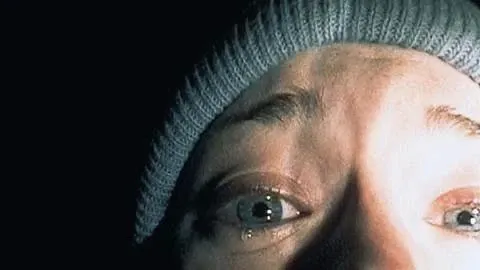
The final shot, showing Heather close-up as she cries and apologizes for involving the two guys in the adventure, is also beautiful in its simplicity and effectiveness. This image was also used for the film’s poster.
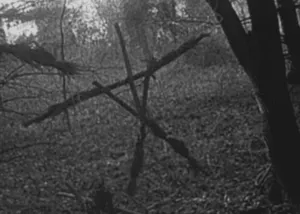 In conclusion, The Blair Witch Project – The Mystery of the Blair Witch has become a cultural phenomenon and a box office success.
It has been praised for its ability to create terror through imagination and suspense, rather than through special effects or gore.
It’s a film that played its cards well, focusing intensely on the primal fear of the dark.
It has influenced many other horror and thriller films that adopted the found footage style, such as “Paranormal Activity” and “Cloverfield.” It has also spawned sequels and adaptations, but none have had the same cultural impact as the original.
The Blair Witch Project – The Mystery of the Blair Witch remains an emblematic example of how innovation in independent cinema can change the landscape of the horror genre and influence how stories are told on the big screen.
Click here to watch our HDE Trailer
Click here to read related articles

Subscribe to our YouTube channel